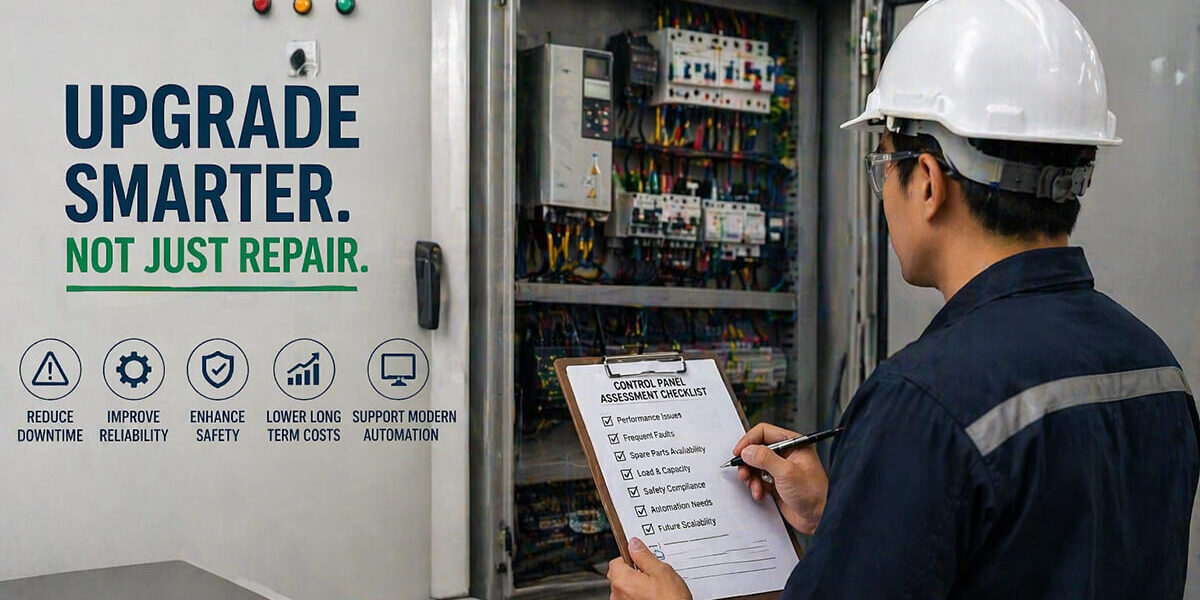
A control panel can often be repaired more than once. But there comes a point when another fix stops being the smart option.
In commercial buildings and industrial facilities, an ageing panel can create repeated faults, safety concerns, rising maintenance costs, and compatibility issues with newer systems. In Singapore, electrical work and maintenance must be handled by licensed electrical workers, and certain licensed installations must also be inspected regularly, so decisions about repair versus upgrade should be made carefully.
Is it always better to repair a control panel first?
Not always.
A repair may make sense when the issue is isolated, spare parts are still available, and the rest of the panel is in sound condition. But when faults keep returning or key components are outdated, the cost of repeated repair can start to outweigh the value of keeping the old system.
That is usually the point where businesses begin reviewing a full electrical control panel in Singapore upgrade rather than another short-term fix.
What are the clearest signs that a control panel should be upgraded?
There are a few signs that usually point towards replacement rather than repair.
1. The same faults keep coming back
If breakers trip often, contactors fail repeatedly, or alarms return after servicing, the panel may no longer be stable enough for reliable operation.
2. Spare parts are difficult to source
Older panels often depend on obsolete components. When replacement parts are no longer readily available, repairs take longer and become less predictable.
3. The panel no longer suits your building’s current load
A system designed years ago may not match current operational demand. This becomes more obvious after equipment upgrades, tenant changes, or added mechanical loads.
4. You want better automation or monitoring
Older panels may not integrate well with modern controls, metering, or remote monitoring, which limits how efficiently the building can be operated.
5. Safety and compliance concerns are increasing
EMA states that electrical work such as installation, repair, maintenance, inspection, and testing must be carried out by the appropriate class of licensed electrical worker. If the panel condition is poor or repeatedly problematic, a proper upgrade review becomes the safer path.
When does repair still make sense?
Repair is still reasonable when the panel structure is sound and the issue is clearly limited.
For example, a damaged relay, faulty breaker, loose termination, or worn contactor may be worth replacing if the panel is otherwise in good condition and still suitable for present demand. In these cases, a qualified contractor can often restore performance without recommending a full rebuild.
The important part is not guessing. A proper technical assessment should come first.
Why do old control panels become a bigger problem in commercial buildings?
Commercial systems usually operate longer and under heavier demand than smaller standalone systems.
That means an old panel is not just an inconvenience. It can affect pumps, HVAC systems, motors, tenant comfort, and daily operations. In facilities that depend on continuous service, recurring control issues can quickly turn into downtime, complaint handling, or unplanned maintenance costs.
This is one reason many building owners consult an electrical control panel builder in Singapore when evaluating whether an older setup is still worth keeping.
How does system expansion affect the repair-versus-upgrade decision?
System expansion often changes the answer.
If your building now needs more automation, more motor control, or better energy management, the original panel may no longer be the right fit. A simple repair might restore power, but it will not necessarily give you the capacity or flexibility your operation now needs.
For example, a facility adding pump sequencing, smarter controls, or monitoring points may need PLC panel fabrication in Singapore rather than another repair to an outdated enclosure.
What if the old panel controls motors or pumps?
Motor-related panels often need closer review because loading, starting method, and efficiency all matter.
If the panel is tied to multiple motors, an MCC panel contractor in Singapore may recommend upgrading once the control arrangement, protection devices, or component condition no longer supports dependable operation. If the issue involves inefficient motor operation, a redesign that includes VSD panel installation in Singapore may improve both control and energy performance.
Can an upgrade help with building integration?
Yes, and this is one of the strongest reasons to upgrade.
Older panels are often harder to connect with modern monitoring platforms or centralised controls. If your building is moving towards better automation, scheduling, or plant visibility, the panel may need to be redesigned for BMS integration in Singapore rather than patched again.
This is especially relevant in commercial properties where HVAC systems, pumps, and monitoring equipment need to communicate more effectively.
Does instrumentation matter when reviewing an old panel?
Very much.
Sometimes the problem is not only the panel itself but also poor signal quality, failing field devices, or inaccurate readings from connected instruments. That is why panel review and instrumentation services in Singapore often go hand in hand in commercial projects.
When the control logic depends on unreliable field data, repeated repairs may only treat the symptoms rather than solve the actual cause.
Are there legal or compliance reasons to upgrade?
There can be.
EMA requires electrical work to be done by licensed electrical workers, and licensed electrical installations must be inspected and certified fit for operation at least once a year by the appointed LEW. EMA also states that, once issued, the electrical installation licence must be displayed near the main switchboard together with an updated single-line drawing.
Separately, BCA announced a Mandatory Energy Improvement regime for existing energy-intensive buildings through amendments to the Building Control Act. While this does not mean every old panel must be replaced, it does show that energy performance and upgrading existing building systems are becoming more important in Singapore.
When is an upgrade usually the better investment?
An upgrade is often the better choice when:
- repair costs keep repeating
- spare parts are obsolete
- the panel no longer matches the building load
- automation or integration is now required
- energy efficiency has become a priority
- reliability matters more than temporary savings
In practical terms, a repair solves today’s fault. An upgrade can solve the next few years of operational problems.
Final Thoughts
There is no fixed age at which every panel must be replaced. The better question is whether the panel is still safe, serviceable, and suitable for how your building operates today.
If the answer is no, upgrading is usually the more practical long-term decision. That is especially true for commercial systems involving pumps, automation, HVAC controls, or ageing motor control equipment.
Conclusion
If your facility is dealing with recurring panel faults, outdated components, or limited system flexibility, it may be time to look beyond repair.
Techtimia Engineering Pte. Ltd supports commercial projects involving control panels, upgrades, automation, and system integration in Singapore. Contact the team to discuss the most suitable approach for your building.