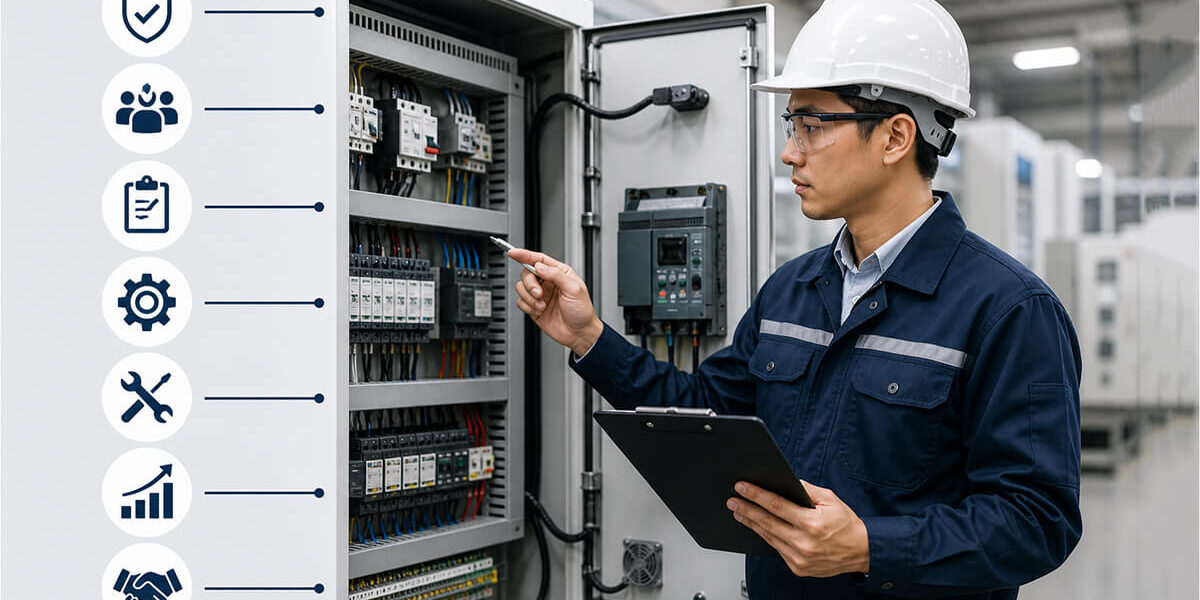
Choosing the right panel builder is not only about price. In a commercial building or industrial facility, the control panel affects safety, uptime, future maintenance, and how easily your systems can expand later.
That is why this decision deserves more than a quick quote comparison. If you are planning a new control panel in Singapore, it helps to know what to check before you commit.
Why does the panel builder matter so much?
A control panel is the point where power, automation, monitoring, and protection come together.
If the panel is poorly designed, you may face repeated faults, difficult maintenance, weak documentation, or trouble integrating with pumps, HVAC systems, and future upgrades. In commercial settings, those issues can quickly become costly.
Should you check licensing and electrical responsibility first?
Yes. This should be one of the first checks.
In Singapore, EMA says electrical work should be carried out or supervised by a Licensed Electrical Worker. That matters because installation, repair, and modification work on electrical systems are regulated activities, not general handyman jobs.
When hiring a panel builder, ask who will handle the electrical work, testing, and coordination with the appointed LEW if your project requires it. A serious contractor should be clear about that from the beginning.
What technical documents should a good panel builder be able to provide?
A reliable builder should be able to explain the design clearly, not just deliver a metal enclosure with components inside.
For many commercial projects, you should expect proper drawings, component schedules, and a single-line drawing that can support installation and future servicing. EMA states that the latest single-line drawing should be kept with the installation documentation and displayed near the main switchboard for licensed installations.
If a contractor is vague about drawings, labels, testing records, or documentation handover, that is a warning sign.
How important is commercial project experience?
It is very important.
Commercial buildings often need more than simple on and off control. They may involve pumps, chilled water systems, motors, instrumentation, alarms, and remote monitoring. A builder with real commercial experience is more likely to understand load changes, service access, downtime risks, and integration needs.
This becomes even more relevant if you need an MCC panel contractor in Singapore for motor-heavy systems or PLC panel fabrication in Singapore for automated control logic.
Should you ask about future system integration?
Definitely.
Many businesses only think about today’s requirement, but a good panel should also support tomorrow’s upgrades. If you may later connect the system to central monitoring, metering, or building automation, the builder should plan for that early.
This is especially important for BMS integration in Singapore, where panel design may need to support communication points, control logic, and clear signal interfaces across multiple building systems. BCA’s Green Mark framework places emphasis on integrated management, controls, and energy monitoring in building operations, which makes future-ready panel design even more relevant in Singapore.
What should you check for motor and HVAC applications?
If the panel will control pumps, fans, blowers, or other motors, ask whether the builder understands the actual operating application.
For example, a project involving multiple motors may need the input of an experienced MCC panel contractor in Singapore. If speed control and energy performance matter, the design may also need VSD panel installation in Singapore rather than a simpler fixed-speed arrangement.
Where the panel is linked to ventilation or mechanical cooling, choosing an HVAC control panel contractor with relevant building services knowledge can make a noticeable difference in long-term reliability.
Do instrumentation and field devices matter when hiring a panel builder?
Yes, more than many buyers expect.
A panel can only perform well if the signals coming into it are accurate and usable. If your system depends on pressure sensors, level transmitters, flow switches, or temperature monitoring, the builder should understand how those field devices interact with the controls.
That is why some projects benefit from combined panel work and instrumentation services in Singapore, especially in pump systems, process areas, or facilities where accurate monitoring affects system performance.
Is after-sales support worth asking about?
Yes, because the job does not end when the panel is installed.
Ask who will handle troubleshooting, replacement parts, modifications, and future expansion. An experienced electrical control panel builder in Singapore should be able to support not only fabrication, but also testing, commissioning, and practical follow-up after handover.
This matters even more if your building runs long hours and cannot afford long downtime during faults.
What is the simplest way to judge whether a builder is the right fit?
Ask whether they understand your operation, not just your drawing.
A strong contractor usually asks smart questions about your load, site conditions, maintenance access, control goals, future expansion, and integration needs. A weak one often talks only about price and delivery time.
That difference shows up later in panel quality.
Final Thoughts
Hiring the right panel builder is really about reducing future problems. You are not just buying a panel. You are choosing how safely, clearly, and efficiently your system will operate after installation.
If the contractor can support proper documentation, commercial-grade design, integration planning, and licensed electrical coordination, you are usually on the right track.
Conclusion
If you are reviewing options for a new control panel, upgrade, or automation project, it helps to work with a contractor who understands both technical design and real commercial operating needs.
Techtimia Engineering Pte. Ltd supports commercial projects involving panel fabrication, system integration, control upgrades, and installation work in Singapore. Contact the team to discuss your project requirements.