Most people notice an air-conditioning system when a room becomes too warm. What they rarely see is the network above ceilings and behind walls that actually moves air around the building.
That network is the ductwork.
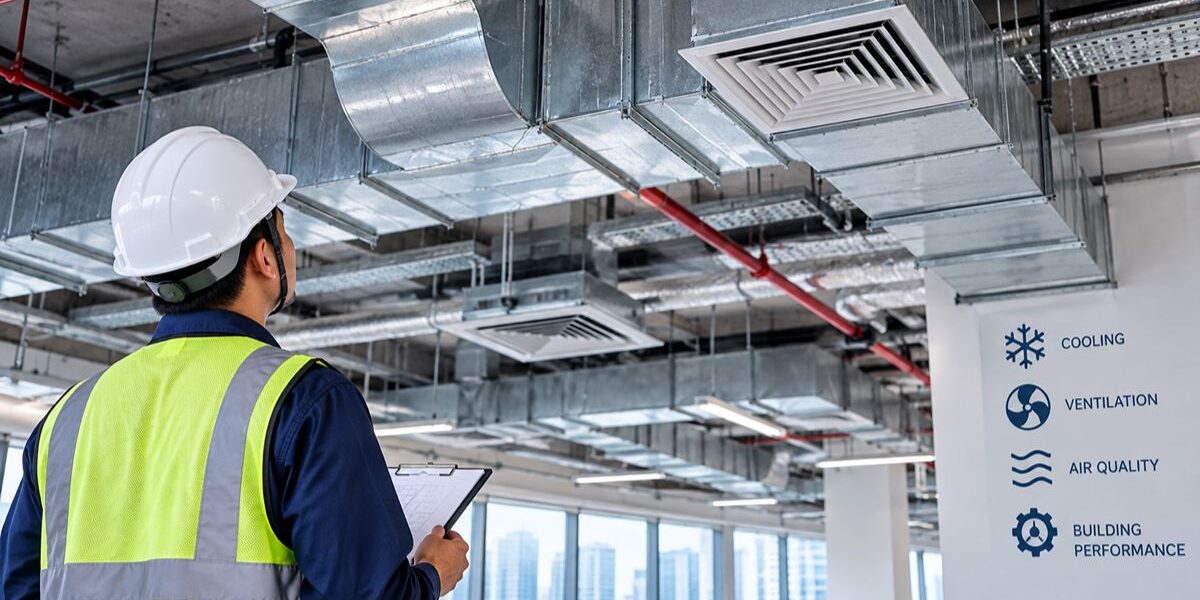
In many Singapore commercial buildings, ACMV ductwork connects air-handling and ventilation equipment with occupied spaces, helping distribute conditioned or fresh air and remove exhaust air where required.
Think of Ductwork as the Air Distribution Network
A typical commercial system can include supply-air ducts, return-air arrangements, fresh-air ducts and exhaust-air ducts, depending on the building design.
Our guide “What Is the Difference Between ACMV and HVAC in Singapore?” provides more background on how these systems fit together.
Why Does Duct Design Matter?
Duct dimensions, routing, fittings, bends, dampers and terminal locations can all affect how easily air travels through the system.
Poorly designed or installed ductwork may contribute to:
- Uneven airflow
- Hot and cold areas
- Excessive noise
- Higher resistance to airflow
- Air leakage
- Difficulty achieving intended ventilation rates
Professional aircon duct fabrication in Singapore should therefore be based on the requirements of the actual ACMV system rather than using a one-size-fits-all arrangement.
What Materials Can Be Used for ACMV Ductwork?
Common options include galvanised steel (GI), stainless steel and aluminium. Flexible ducts and flexible connections may also be used in appropriate parts of a system.
Singapore’s current SCDF Fire Code specifies requirements for ACMV and ventilation duct construction, including permitted materials, adequate supports, duct coverings and linings, flexible joints and fire-rated ductwork where required.
Material selection should therefore consider not only airflow requirements but also the location, application and applicable fire-safety provisions.
Good Ductwork Supports Better Airflow
If some rooms receive too much air while others receive too little, simply changing the thermostat may not solve the underlying problem. Dampers, duct sizing, leakage, obstructions or system changes may need investigation.
Ductwork Also Matters for Indoor Air Quality
Singapore’s BCA, NEA and MOH ventilation guidance recommends checking air ducts and dampers for leakage or blockage as part of ACMV maintenance. It also emphasises keeping ventilation systems in good working condition and maintaining appropriate outdoor-air supply.
However, aircon duct cleaning in Singapore should not automatically be treated as the answer to every indoor air-quality problem. Filters, outdoor-air supply, coils, moisture conditions, ventilation rates and maintenance practices can also influence indoor conditions.
The cause should be assessed before deciding what corrective work is necessary.
What Happens When Ductwork Develops Leaks?
When conditioned air escapes before reaching the intended space, the system may not deliver airflow as designed. Leakage can also make balancing more difficult.
Signs worth investigating include weak airflow, unexplained differences between rooms, damaged duct sections or visible problems around joints.
Professional aircon duct repair in Singapore may involve identifying the source of leakage, rectifying damaged sections or modifying connections rather than replacing an entire duct network.
When Might Existing Ductwork Need Modification?
An office may be repartitioned, a retail space may change tenants, or an industrial facility may introduce new equipment. These changes can alter airflow requirements even when the existing ACMV equipment remains operational.
Duct modification or extension may be necessary when:
- Room layouts change
- New areas require ventilation
- Equipment is relocated
- Airflow remains uneven
- Existing ducts are damaged
- Exhaust requirements change
Modifications should consider the wider system rather than treating each new duct section independently.
Fire Safety Cannot Be Separated From Ductwork Design
SCDF’s Fire Code contains specific provisions governing ACMV duct materials, supports, fire dampers, fire-rated ducts and penetrations through fire compartments. The requirements depend on the duct’s location and application.
This is one reason commercial ductwork fabrication and installation should be properly planned instead of being treated as simple sheet-metal work.
What Should Businesses Expect From Aircon Duct Services?
Depending on the project, work may include site measurement, fabrication, installation, duct modification, insulation, cladding, flexible connections, dampers, grilles, diffusers, supports, leakage rectification and airflow testing.
The contractor should also understand how the ductwork interacts with the wider ACMV system. “What Should Businesses Look for in an HVAC and ACMV Contractor in Singapore?” provides additional points facility managers can consider when selecting technical support.
Conclusion
Good design, suitable materials, proper installation and ongoing inspection can support airflow, indoor comfort and reliable ACMV operation. When ductwork is leaking, damaged or poorly configured, addressing the distribution system may be just as important as servicing the equipment itself.
Techtimia Engineering Pte. Ltd provides duct fabrication, installation, modification, insulation, leakage rectification and related ACMV ductwork services for commercial and industrial facilities in Singapore. Arrange a site assessment if you are planning new ductwork or need to investigate problems with an existing air distribution system.